Every year, hundreds of workers suffer serious injuries—or worse—during equipment maintenance. The root cause? Improper or nonexistent lockout tagout (LOTO) procedures. A single missed step can lead to unexpected machine startup, exposing personnel to crushing, electrocution, or amputation hazards.
The lockout tagout procedure PDF isn’t just paperwork—it’s a lifeline. Used correctly, it standardizes safety protocols, ensures regulatory compliance, and protects teams during servicing and maintenance. This guide breaks down what a LOTO procedure PDF should include, how to create one, where to find reliable templates, and what real-world execution looks like.
Why a Lockout Tagout Procedure PDF Matters
A LOTO procedure PDF serves as a formal, accessible, and consistent reference for controlling hazardous energy. Unlike verbal instructions or memory-based routines, a documented procedure eliminates guesswork and reduces human error.
OSHA standard 29 CFR 1910.147 mandates that employers implement a written energy control program. A PDF format ensures that this documentation is:
- Portable – Accessible on tablets, phones, or printouts at the worksite
- Standardized – Uniform across shifts, departments, and locations
- Trackable – Version-controlled and audit-ready
- Trainable – Integrated into onboarding and refresher courses
Without a clear, documented LOTO process, companies risk noncompliance, fines, and—more critically—preventable injuries. A well-structured PDF turns policy into practice.
Key Components of a Lockout Tagout Procedure PDF
Not all LOTO PDFs are created equal. A high-quality document should go beyond basic checklists and include these core elements:
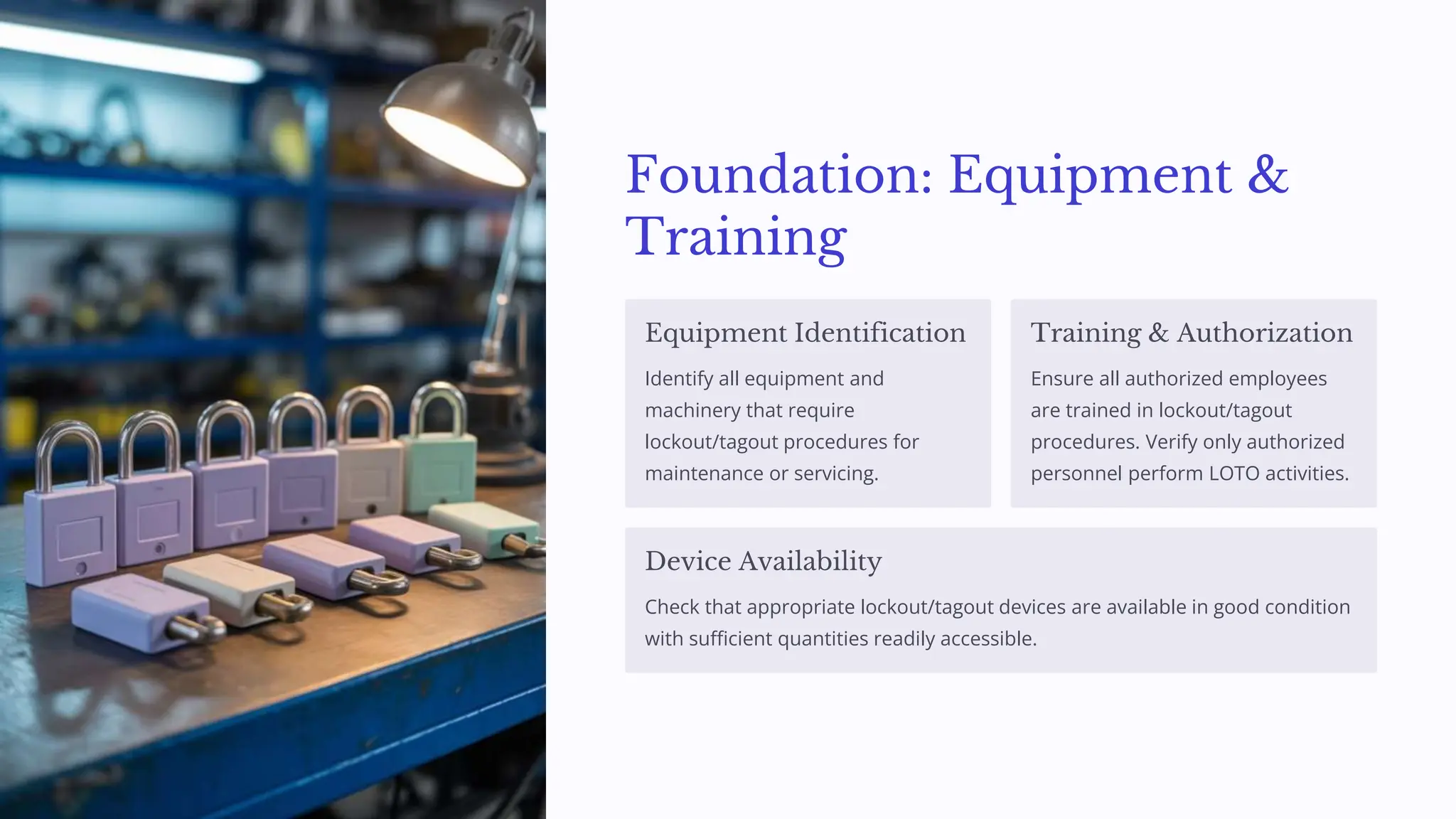
1. Equipment Identification Clearly name and describe the machine or system. Include location, model number, and energy sources (electrical, hydraulic, pneumatic, chemical, etc.). Example: “Hydraulic Press – Model HP-3200, Line 4, South Facility – Powered by 480V 3-phase electrical and hydraulic fluid under 2,500 psi.”
2. Authorized Personnel List Identify who is trained and permitted to perform LOTO. This ensures accountability and prevents unqualified workers from initiating or removing locks.
3. Step-by-Step Shutdown and Isolation Sequence Detail each action required to safely de-energize the equipment: - Notify affected personnel - Shut down using normal controls - Isolate all energy sources (disconnect switches, close valves, block moving parts) - Apply locks and tags to each isolation point
4. Verification of Zero Energy Specify how to confirm the machine cannot restart. This includes attempting a startup (with safeguards in place) and testing for residual energy.

5. Release and Restoration Steps Outline how to safely remove locks, re-energize, and return the equipment to service—only after ensuring all tools are removed and personnel are clear.
6. Visual Aids and Diagrams Include schematics showing lock placement, energy isolation points, and tag locations. A labeled diagram prevents confusion in high-stress situations.
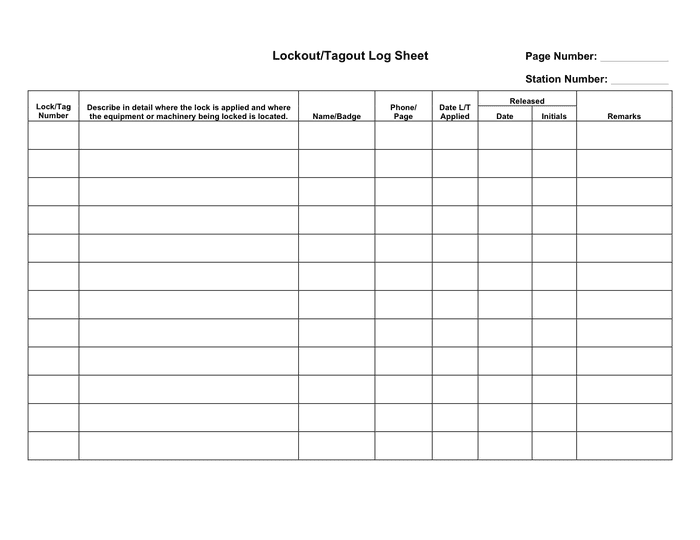
7. Revision and Approval Log Track who created, reviewed, and updated the procedure, along with dates. This supports audit trails and continuous improvement.
Common Mistakes in LOTO Procedure PDFs
Even documented procedures fail when poorly designed. These are frequent pitfalls:
- Vague Instructions: “Turn off power” isn’t enough. Specify which disconnect and how to verify it’s off.
- Missing Energy Types: Overlooking stored energy (e.g., springs, capacitors, gravity) can lead to sudden release.
- No Verification Step: Skipping the “try to start” test leaves uncertainty.
- Generic Templates, No Customization: Using a one-size-fits-all PDF without adapting to specific machinery creates false confidence.
- Outdated or Unversioned Files: Old PDFs with obsolete steps circulate if not properly managed.
A real-world example: A maintenance crew used a generic LOTO PDF for a conveyor system. The document didn’t mention a tensioned spring in the drive mechanism. During service, the spring released, causing a severe hand injury. The fix? Custom, equipment-specific PDFs with mechanical hazard assessments.
How to Create a Custom LOTO Procedure PDF
Creating an effective LOTO PDF isn’t about formatting—it’s about precision and usability. Follow this workflow:
Step 1: Conduct an Equipment Energy Audit Walk through each machine. Identify every energy source and point of isolation. Use a checklist: - Electrical disconnects - Hydraulic/pneumatic valves - Gravity-fed systems - Stored rotational or thermal energy
Step 2: Map the Lockout Sequence Write out each action in order. Involve maintenance staff—they know operational nuances. Tip: Film a mock LOTO session to validate the steps.
Step 3: Design the PDF Layout Use clear headings, numbered steps, and icons. Place warnings in red boxes. Embed QR codes linking to digital versions or training videos.
Step 4: Review and Approve Have safety officers, engineers, and experienced technicians review the draft. Test it in a live (but safe) scenario.
Step 5: Distribute and Train Load the PDF into your LMS, print laminated copies, and conduct drills. Re-train annually—or when procedures change.
Top 5 Sources for Lockout Tagout Procedure PDF Templates
While custom procedures are ideal, starting with a professional template accelerates compliance. Here are five trusted sources:
| Source | Key Features | Best For |
|---|---|---|
| OSHA.gov | Free, regulation-aligned templates | Public sector, small businesses |
| ANSI/ASSE Z244.1 Compliant Templates (SafetyNow) | Industry-standard format, editable PDFs | Manufacturing, heavy industry |
| Creative Safety Supply | Visual-heavy, multilingual options | Facilities with diverse workforces |
| EHS Daily Advisor (BLR) | OSHA-reviewed, customizable fields | Compliance-first organizations |
| Lockout Tagout Solutions (LOTO.com) | Machine-specific templates, audit tools | High-risk environments (chemical, oil/gas) |
Note: Always customize templates. A boilerplate PDF for a CNC machine won’t fit a boiler system.
When a LOTO PDF Isn’t Enough: Beyond the Document
A PDF is a tool—not a solution. Real safety happens when culture, training, and systems align. Consider these enhancements:
- Digital LOTO Systems: Replace static PDFs with mobile apps that guide users step-by-step, log actions, and require photo verification.
- Group Lockout Procedures: For multi-person jobs, use hasp locks and master tags with individual accountability.
- Annual Audits: OSHA requires periodic inspections. Use your PDF as a checklist during walkthroughs.
- Near-Miss Reporting: Encourage workers to report LOTO close calls—then update PDFs accordingly.
Example: A food processing plant introduced tablet-based LOTO. Technicians scan a QR code on the machine, pull up the live PDF, and check off steps with photo confirmation. The system logs timestamps and personnel, reducing bypass incidents by 70%.
Real-World Use Case: Implementing LOTO in a Packaging Facility
A mid-sized packaging company had recurring injuries during jam clearance on conveyor lines. Investigation revealed inconsistent lockout practices.
Solution: - Audited all 12 conveyor systems - Created machine-specific LOTO PDFs with diagrams - Installed lockout stations with standardized kits - Trained 85 employees, including bilingual materials - Integrated PDFs into shift handover checklists
Results: - Zero LOTO-related incidents in 18 months - Passed OSHA audit with no citations - Reduced downtime by 15% due to faster, clearer procedures
The LOTO PDF became the backbone of their safety culture—not a file buried in a folder, but a living document posted at every machine.
Final Steps: Turning Your LOTO PDF into Action
A lockout tagout procedure PDF only works when it's used, understood, and trusted. Don’t treat it as a compliance checkbox. Instead:
- Review it quarterly—update for equipment changes
- Print and post at or near each machine
- Include it in onboarding—new hires should see it on day one
- Use it in drills—simulate failures to test response
The best LOTO PDF is clear, specific, and alive—constantly improved through real-world feedback.
Start today: Pick one high-risk machine, build its LOTO PDF from scratch, and test it with your team. That single document could prevent the next accident.
Frequently Asked Questions
What should a lockout tagout procedure PDF include? It must list equipment details, energy sources, shutdown steps, isolation points, verification methods, and authorized personnel—with clear visuals and revision history.
Are free LOTO PDF templates reliable? Only as a starting point. Always customize for your equipment and verify compliance with OSHA 1910.147.
Who should create the LOTO procedure PDF? A team including safety officers, maintenance leads, and equipment operators to ensure accuracy and usability.
Can a LOTO PDF be digital instead of printed? Yes, if accessible during maintenance (e.g., on rugged tablets) and part of a controlled document system.
How often should LOTO PDFs be updated? After equipment modifications, incident reviews, or at least annually during compliance audits.
Do all employees need to read the LOTO PDF? Affected employees must be trained on its contents. Only authorized personnel perform the procedure.
What happens if a LOTO PDF isn’t followed? Risk of severe injury, OSHA fines (up to $145,027 per violation), and potential criminal liability in fatal cases.
FAQ
What should you look for in Lockout Tagout Procedure PDF Guide for Workplace Safety? Focus on relevance, practical value, and how well the solution matches real user intent.
Is Lockout Tagout Procedure PDF Guide for Workplace Safety suitable for beginners? That depends on the workflow, but a clear step-by-step approach usually makes it easier to start.
How do you compare options around Lockout Tagout Procedure PDF Guide for Workplace Safety? Compare features, trust signals, limitations, pricing, and ease of implementation.
What mistakes should you avoid? Avoid generic choices, weak validation, and decisions based only on marketing claims.
What is the next best step? Shortlist the most relevant options, validate them quickly, and refine from real-world results.